
How to Stay Active on Slack Without Touching Your Mouse
Wiggling the mouse outside the Slack window never did anything. The three ways to stay active with no mouse input at all, what each costs, and why the wiggling advice fails.
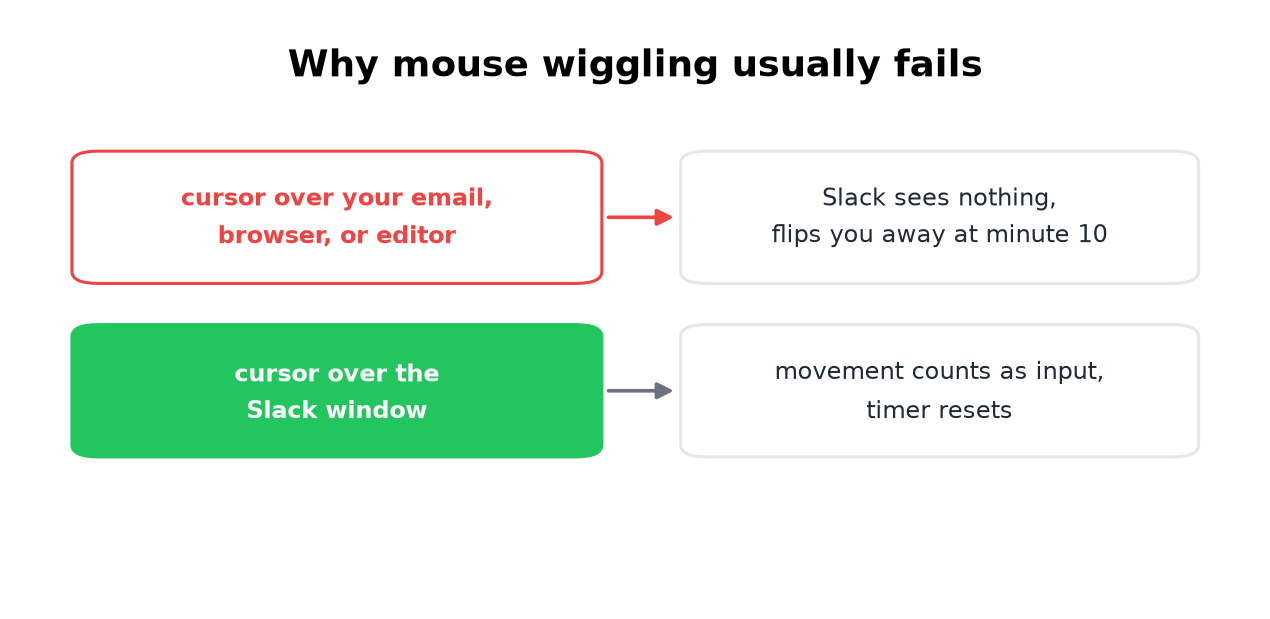
Slack marks you away 10 minutes after your last click, keystroke, or scroll inside a Slack window. Input anywhere else does not count, which is why the classic advice, wiggle the mouse now and then, mostly does nothing: unless the cursor happens to sit over Slack, the wiggling is invisible to it.
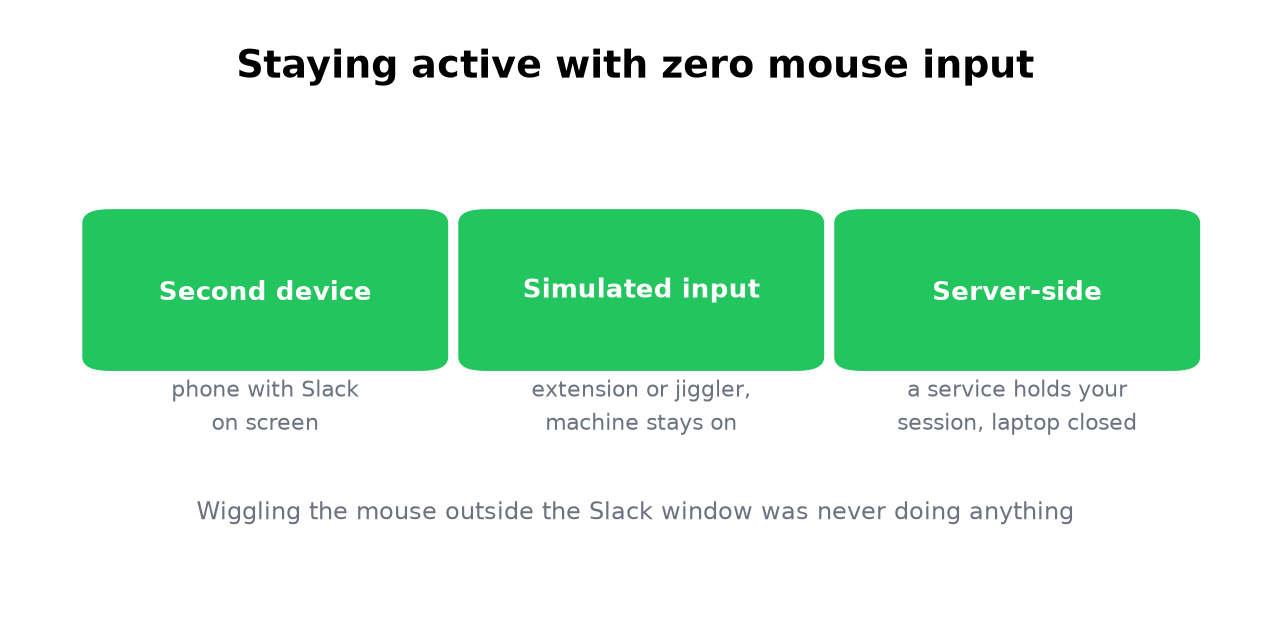
There are exactly three ways to stay active with no mouse input at all. This page compares them honestly, as the no-hands chapter of how to keep Slack active. We build Slack Green, the tool behind the third one, and it started as the founder's fix for this exact problem.
What resets the activity timer
Slack counts interaction with Slack itself: typing, clicking, scrolling, switching channels inside its window. Reading without input does not count. Working in other apps does not count. Slack does not track your mouse outside its own window, which is the whole reason wiggling fails.
The exact timers per device, including why sleep flips you instantly, are in how long does Slack stay active.
The three no-mouse methods
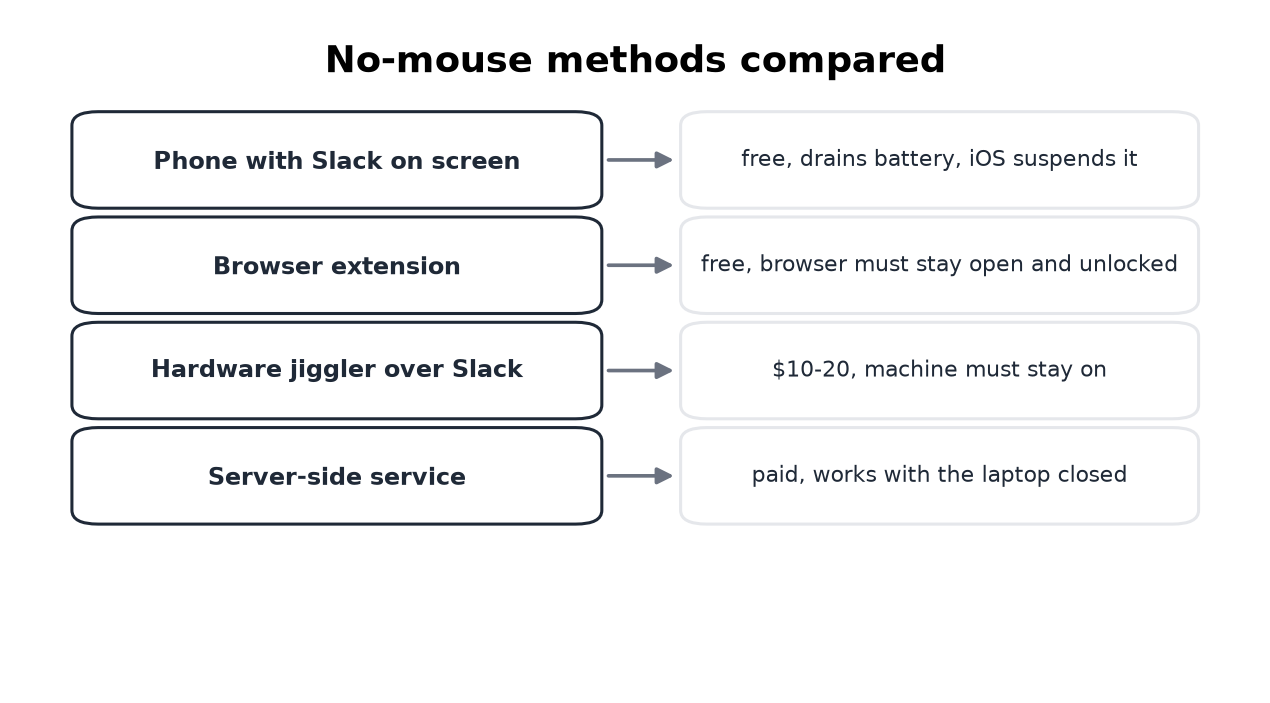
1. A second device. Slack reads presence across all sessions, so a phone with the app open and the screen forced on holds you green. Free, immediate, and fragile: the battery drains, the screen must stay unlocked, and iOS suspends the app when it wants. Details in keeping Slack active on mobile.
2. Simulated input inside Slack. A browser extension can generate in-tab activity, or a hardware jiggler can nudge a cursor parked over the Slack window. Both work while the machine stays on and unlocked, and both die with the machine. The trade-offs are in Slack Green vs mouse jigglers.
3. A server-side service. It signs in as your Slack session and refreshes presence from a server. Nothing runs on your machine, and the laptop can be closed. That is Slack Green: set a schedule and the dot follows your working hours. The honest cost applies to every tool in this class, ours included: you trust a service with a session token, so read the security notes first.
The wider comparison, including the methods that do need your hands, is in how to keep Slack active.
What does not work
Never appear "away" on Slack again
Cloud-based. No downloads. Works 24/7 even when your laptop is off.
- • Wiggling over your email or editor. Invisible to Slack.
- • Keeping the Slack window open without input. Away at minute 10.
- • Keep-awake apps alone. They stop the sleep flip and nothing else, as the Caffeine test shows.
- • A status message. Text and the presence dot are
Frequently asked questions
How do I stay active on Slack without moving the mouse? Second device, simulated input inside Slack, or a server-side service. Those are the only three. Everything else is a variation or does not work.
Does wiggling the mouse keep Slack active? Only if the cursor is over the Slack window. Anywhere else, Slack cannot see it, and you flip to away at ten minutes regardless.
How do I stay online on Slack when my laptop is closed? Only the server-side option survives a closed lid. Simulated input needs a running machine, and a phone holds on only while its screen stays on.
Is staying active automatically against Slack's rules? Automating your own session is a gray zone Slack has not enforced against individuals. Your employer's policy usually matters more: will I get caught.
The short version
The mouse was never the point. Slack counts input inside its own window, so staying active without touching anything means a second device, input simulated inside Slack, or a server that does it for you. The third one is the only method that works with the laptop shut, and it is the reason Slack Green exists. Setup takes about two minutes.
Stop Jiggling Your Mouse.
Join hundreds of remote workers who never worry about their Slack status. Set it up once, stay green forever.
Related Articles
Funny Slack Status Ideas That Survive a Work Channel
Copy-paste funny Slack statuses sorted by situation: deep work, meetings, lunch, Friday, and out of office. The two rules that keep a joke work-safe, and why the status never touches your green dot.
How to Keep Teams and Slack Active at the Same Time
Slack counts input inside its own window on a 10-minute timer. Teams reads keyboard and mouse anywhere, on 5. One trick rarely covers both, and the setups that do are specific.
How to Keep Slack Active in the Browser
Slack in a browser tab follows the same 10-minute timer as the desktop app, with two extra ways to die: tab discarding and the browser closing. What counts as input in a tab, the Memory Saver and sleeping-tabs exceptions, and when the tab beats the app.