
How to Keep Slack Active on a Chromebook
A Chromebook runs Slack two ways, a browser tab or the Android app, and they follow different presence rules. The ChromeOS power settings that stop the instant away, the Memory Saver trap, what works on managed school and work devices, and what does not.
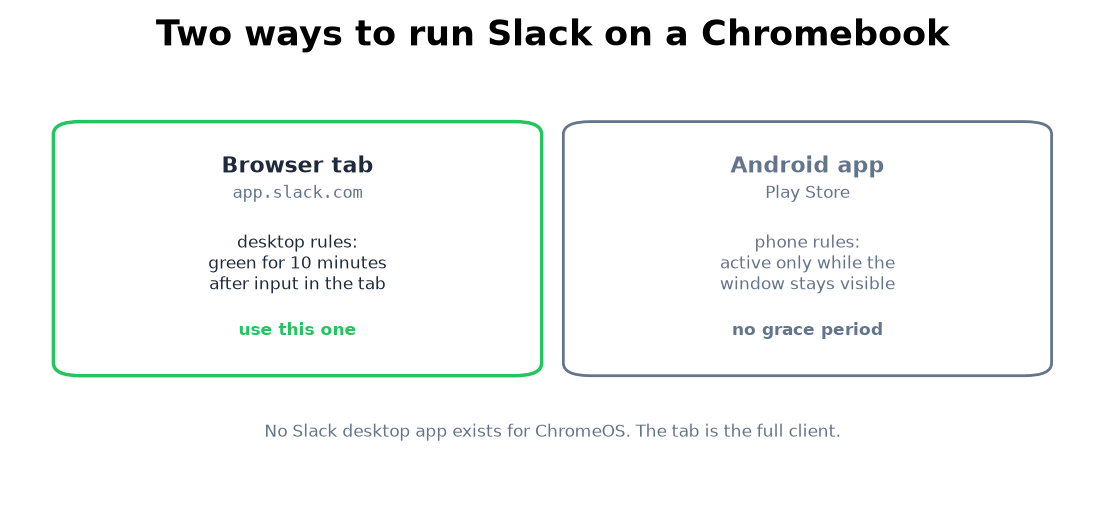
There is no Slack desktop app for ChromeOS, so a Chromebook runs Slack one of two ways: a browser tab at app.slack.com, or the Android app from the Play Store. They follow different presence rules, and the browser tab is the one that behaves like a desktop: green for 10 minutes after your last click, keystroke, or scroll inside the Slack tab. Around that timer, ChromeOS adds its own ways to cut the dot early: display sleep, lid close, and Chrome's Memory Saver quietly discarding the tab. This page covers the Chromebook specifics, what works on managed school and work devices, and where the on-device options end. One of the options past that line is Slack Green, the server-side tool we build; the full method comparison lives in how to keep Slack active.
Tab or Android app: different rules
The browser tab follows the desktop rules. Input inside the Slack tab resets a 10-minute timer; input anywhere else does not count, because Slack cannot see it. The tab does not need to be focused to stay connected; it needs to have seen input in the last 10 minutes.
The Android app follows the phone rules: it reports you active only while its window is visible on screen. Minimize it and the dot starts dying in seconds, the same behavior as on a phone, covered in keep Slack active on mobile. On a Chromebook the app window can stay visible next to your work, which makes it a weak version of the split-screen trick from the Android page.
For staying green, use the tab. It gets the 10-minute grace period; the app gets none.
The ChromeOS settings that cut you off early
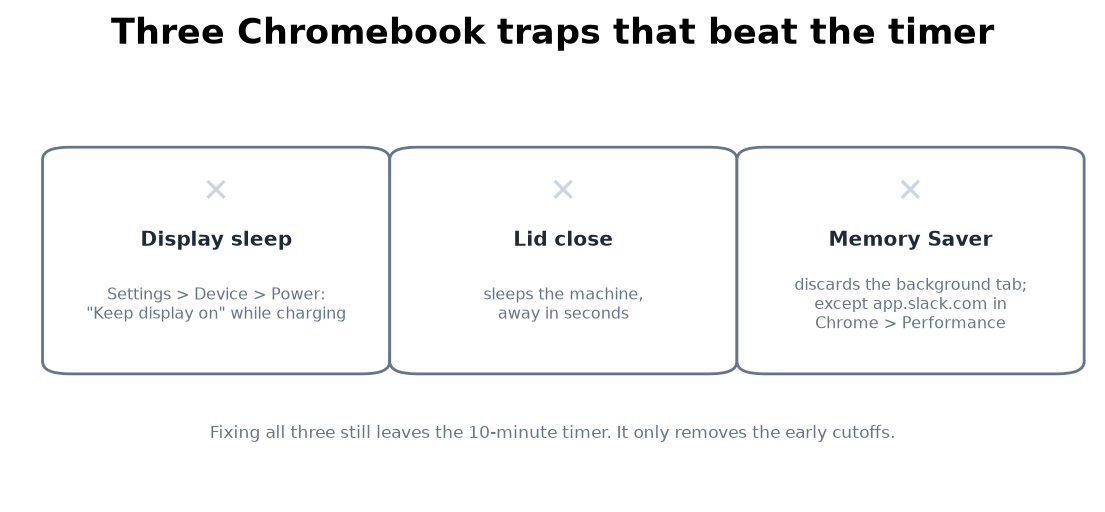
Three things flip a Chromebook to away before the timer even runs:
- Display sleep. Settings, Device, Power: set "When idle" to "Keep display on" while charging, or at least stretch the timing. A slept or locked Chromebook reports nothing.
- The lid. Closing it sleeps the machine and drops the dot in seconds. There is no clamshell mode on most Chromebooks without an external display setup.
- Memory Saver. Chrome discards background tabs to save RAM, and a discarded Slack tab is a disconnected Slack. Chrome Settings, Performance: add app.slack.com to "Always keep these sites active". This is the trap people miss, because the tab looks open while it has actually been unloaded.
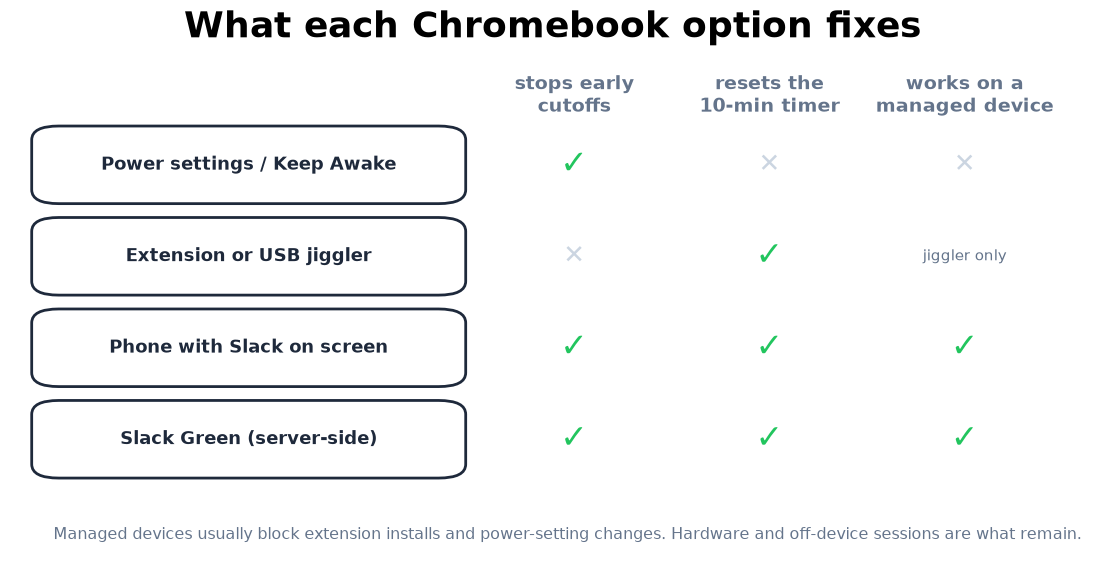
Google's own Keep Awake extension toggles display sleep from the toolbar if you prefer a switch over settings. All of this only stops the early cutoffs; a wide-awake Chromebook still flips you away 10 minutes after your last input in the Slack tab.
What resets the timer on a Chromebook
Nunca mais apareça como "ausente" no Slack
Na nuvem. Sem downloads. Funciona 24/7 mesmo com seu notebook desligado.
The managed-Chromebook case
School and work Chromebooks are usually enrolled in an admin console that locks the power settings, blocks extension installs, and sometimes pins the whole session. On those devices the realistic list shrinks to three: touching Slack yourself, a USB jiggler (hardware is invisible to admin policy, though the moving cursor is not), and presence that never touches the device, which is the server-side category. That last one is why Slack Green works the same on a locked-down Chromebook as on any other machine: it does not run there.
Chromebook questions people search
Is there a Slack app for Chromebook? No desktop app. You get the web app in a tab, which is the full Slack, or the Android app from the Play Store, which is the phone version. For presence, the tab is better: it carries the 10-minute timer, the Android app reports only while visible.
How do I install Slack on a Chromebook? Open app.slack.com in Chrome and sign in; pin the tab or install it as a shortcut from Chrome's menu. The Play Store route works too, with phone-app presence rules.
Why does Slack show me away on my Chromebook while the tab is open? Either 10 minutes passed without input in the tab, the display slept, or Memory Saver discarded the tab. The fixes for all three are above; the general diagnosis walkthrough is in Slack keeps showing away while working.
Does closing the Chromebook lid log me out? It sleeps the machine, which drops your presence in seconds. Signing back in restores the session; only a second device or a server-side session stays green through it.
Can I keep Slack active on a school or work Chromebook? Extensions and power settings are usually blocked by the admin. A USB jiggler over the Slack tab works at a desk; a server-side session works from anywhere and touches nothing the admin manages.
The short version
Nunca mais apareça como "ausente" no Slack
Na nuvem. Sem downloads. Funciona 24/7 mesmo com seu notebook desligado.
Run Slack in a tab, not the Android app; the tab gets the 10-minute timer. Stop the early cutoffs: display set to stay on, lid open, app.slack.com excepted from Memory Saver. Then feed the timer by hand, with an extension or USB jiggler, from a phone, or from a server with Slack Green, which is also the only route that survives a managed device and a closed lid. Every method compared: how to keep Slack active.
Pare de Mexer o Mouse.
Centenas de trabalhadores remotos não se preocupam mais com o status do Slack. Configure uma vez, fique verde para sempre.
Related Articles
Funny Slack Status Ideas That Survive a Work Channel
Copy-paste funny Slack statuses sorted by situation: deep work, meetings, lunch, Friday, and out of office. The two rules that keep a joke work-safe, and why the status never touches your green dot.
5 ferramentas para manter o Slack verde, julgadas por duas perguntas
Toda ferramenta que promete um ponto verde no Slack responde a duas perguntas. Ela cria entrada dentro do Slack? E sobrevive ao notebook fechado? Classifique as cinco opções populares por essas duas perguntas e os vereditos se escrevem sozinhos.
How to Keep Teams and Slack Active at the Same Time
Slack counts input inside its own window on a 10-minute timer. Teams reads keyboard and mouse anywhere, on 5. One trick rarely covers both, and the setups that do are specific.