
Can Slack Messages Be Subpoenaed? Yes, Here Is How It Works
Yes. Slack messages, including DMs, can be requested in a lawsuit or an investigation. Most requests go to the company that owns the workspace, which exports them. Slack itself gives out message content only with a search warrant and tells the company first. Slack's own policy, its disclosure numbers, legal holds, and what deleted messages mean.
Yes, Slack messages can be subpoenaed, and that includes direct messages and private channels. In most lawsuits the request goes to the company that owns the Slack workspace, because Slack's own policy says "third parties seeking Customer Data should contact the Customer". The company then exports the messages with Slack's export tools, a legal hold, or the Discovery API. When the request goes to Slack itself, Slack says it needs "a search warrant issued by a court of competent jurisdiction or the equivalent legal process" to hand over message content, and it tells the company before it does, unless a court forbids that.
In 2021, the latest year Slack has published, government subpoenas to Slack produced no message content at all: 22 subpoenas, 0 with content, 19 with account data only. All 5 search warrants produced content.
We build Slack Green, which keeps your Slack status green during your working hours. It only sets presence and never reads messages. We read Slack's Data Request Policy, its Transparency Report and its help articles on 28 September 2026. This page explains how the process works; it is not legal advice.
How Slack messages get into a lawsuit or investigation
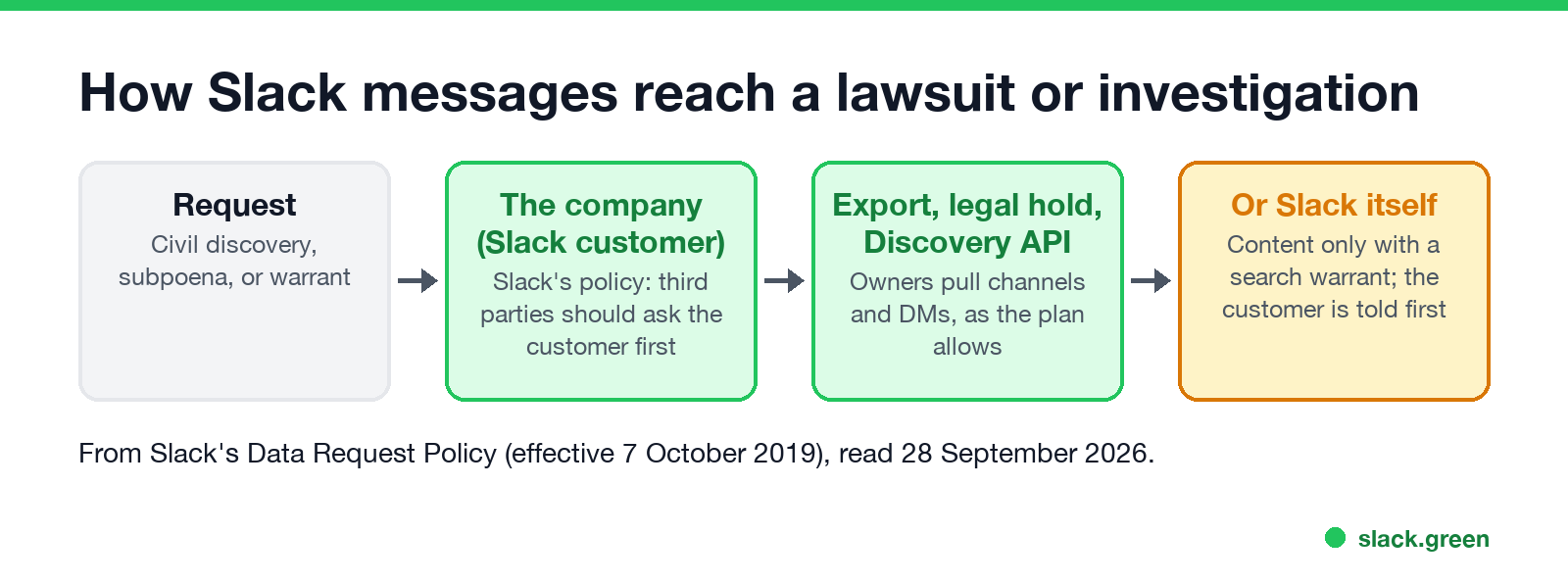
There are two routes, and the first is far more common.
Through the company. In a civil case, the other side asks the company for relevant records in discovery, and Slack messages are records like email. Slack calls the company that pays for the workspace the "Customer" and says the Customer "controls the Customer Data and generally gets to decide what to do with" it. The company's Owners export what is needed. How much they can export depends on the plan:
| Plan | What Owners can export for a legal matter |
|---|---|
| Free and Pro | Public channels. Private channels and DMs only after applying to Slack, each time, with valid legal process, member consent, or a legal requirement |
| Business+ | Public channels, private channels and DMs, after the Owner is approved once for the export tool |
| Enterprise | All of the above, per member or per conversation, plus legal holds and the Discovery API for eDiscovery tools |
The plan-by-plan details, with Slack's wording, are in can Slack admins see your DMs.
Through Slack. Governments and parties in litigation can also serve legal process on Slack. Requests for customers of the US company go to legalprocess@slack.com, and for customers of the Irish company to intlegalprocess@slack.com. Slack says it construes requests "narrowly", discloses content only with a warrant or its equivalent, and does not accept legal process directly from law enforcement outside the US and Canada for data stored in the US; those agencies have to go through a Mutual Legal Assistance Treaty.
What Slack hands over when it gets a subpoena
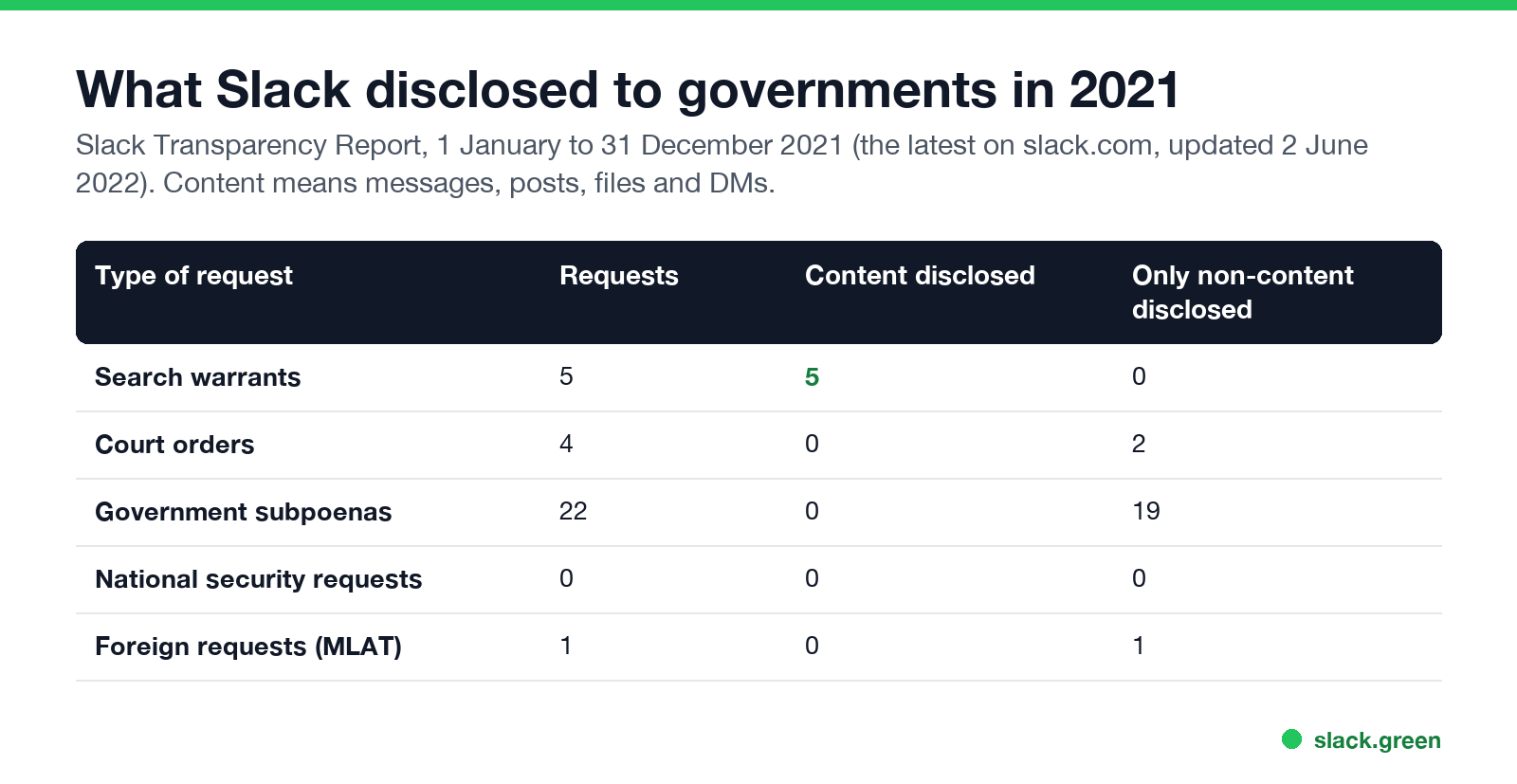
Slack's Transparency Report separates "content data" (messages, posts, files and DMs) from "non-content data" such as account and billing details and access logs. Its numbers for 1 January to 31 December 2021:
| Type of request | Requests | Content disclosed | Only non-content disclosed |
|---|---|---|---|
| Search warrants | 5 | 5 | 0 |
| Court orders | 4 | 0 | 2 |
| Government subpoenas | 22 | 0 | 19 |
| National security requests | 0 | 0 | 0 |
| Foreign requests through an MLAT | 1 | 0 | 1 |
So a subpoena sent straight to Slack gets account records, not messages. A warrant gets messages. This matches the report's own definition: "A search warrant is required to obtain the content of communications."
Before disclosing anything, Slack says it notifies the customer "so that the Customer may seek legal remedies", unless it is legally prohibited or there is "a clear indication of illegal conduct or risk of harm". The notice goes to the company, not necessarily to you as a member.
Slack legal holds and eDiscovery
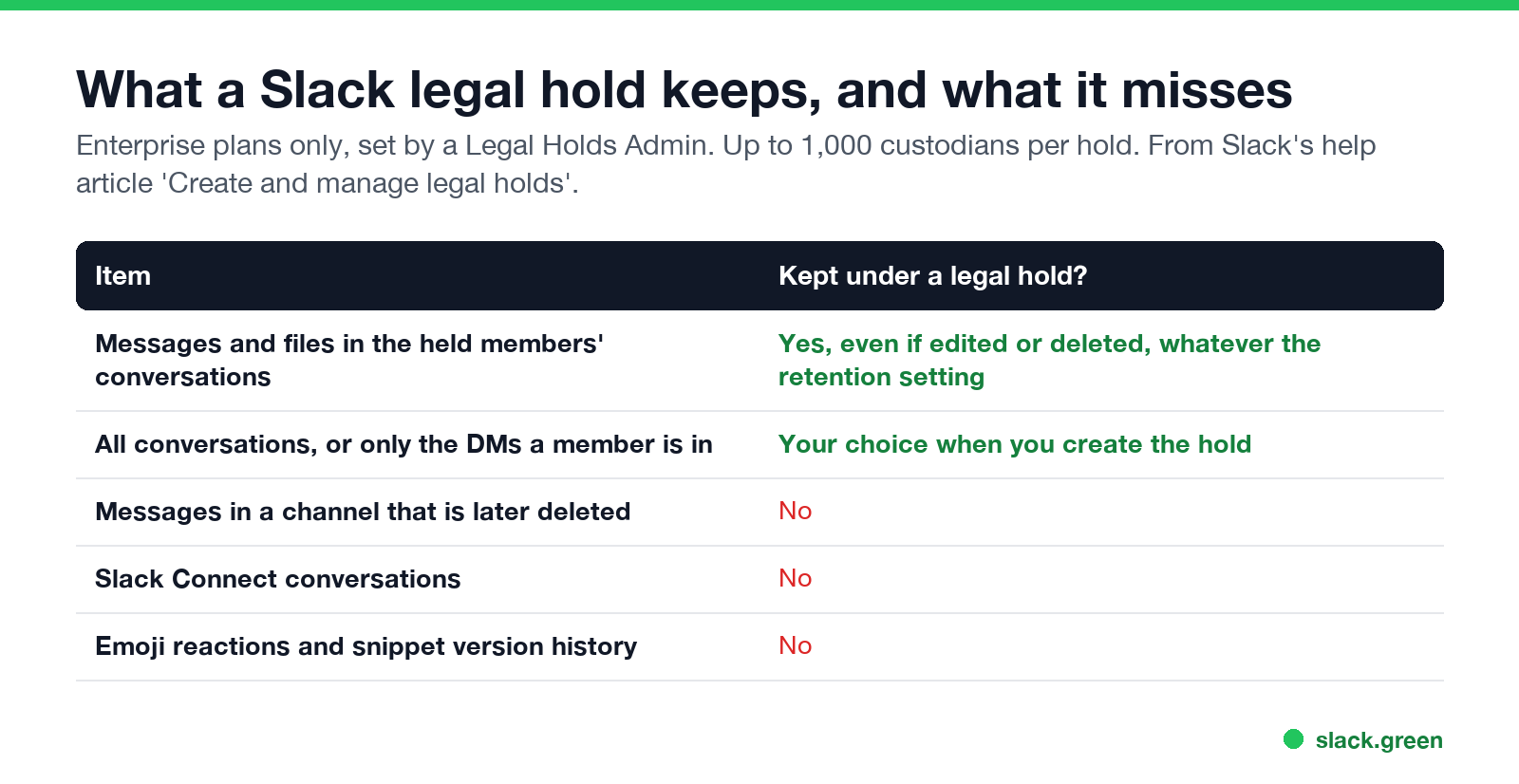
On Enterprise plans, a member with the Legal Holds Admin role can place a legal hold on specific people, called custodians. Slack's help article says:
- • With a hold in place, messages and files "will be saved regardless of retention settings or if members edit or delete any content".
- • The hold can cover all of a member's conversations or only their DMs, with an optional date range.
- • Held data "can be accessed from a JSON export or using the Discovery API".
- • Messages in a channel that is later deleted are not saved, and Slack Connect conversations, emoji reactions and snippet version history are not included.
- • One hold can have up to 1,000 custodians, and there is no limit on the number of holds.
The Discovery API is how eDiscovery and archiving tools such as Global Relay, Smarsh and Proofpoint pull Slack data for review. What Slack records about admin and member activity is in Slack audit logs.
Never appear "away" on Slack again
Cloud-based. No downloads. Works 24/7 even when your laptop is off.
Can deleted Slack messages be subpoenaed?
Only if they still exist. On paid plans the Owner can choose to keep every message with its edit and deletion history, and a legal hold on Enterprise keeps deleted messages for the held members. Otherwise a deleted message is gone from Slack's side too. The details by retention setting are in can Slack see deleted messages and Slack message retention policy.
Deleting messages after you know about a lawsuit or investigation is a different matter. Courts can treat it as destroying evidence, and on a workspace with a hold or a keep-everything setting the deleted message is still there, with a record that you deleted it.
Private conversations in internal investigations
The query "investigation Slack private conversations" usually means an HR or compliance investigation, not a court case. Nobody at the company can open your DMs in the Slack app. On Business+ and Enterprise, an approved Owner can export them, and on Enterprise an Org Owner can export everything one person was part of, or send it to an eDiscovery tool. Whether they may do so is set by your employment contract, company policy and local law; see can Slack be used to monitor employees and is it legal for my employer to monitor me.
Slack is not end-to-end encrypted, which is why these exports are possible at all; see is Slack end-to-end encrypted.
FAQ
Can Slack DMs be subpoenaed?
Yes. DMs are Customer Data like channel messages. In a lawsuit they usually come from the company's export or legal hold. From Slack directly, content needs a search warrant.
Can Slack messages be used in court?
Yes. Messages produced through discovery, exports or a warrant can be offered as evidence, like email. Whether a court admits a given message is a question for the court.
Does Slack tell you if your messages are subpoenaed?
Slack notifies its customer, the company that owns the workspace, unless it is legally barred. It does not promise to notify each member.
Can my employer read my Slack DMs for an investigation?
Not in the app. On Business+ and Enterprise, an approved Owner can export DMs, and on Enterprise an Org Owner can put you on a legal hold or export all your conversations.
Can a personal Slack workspace be subpoenaed?
Yes. The same rules apply: the workspace Owner is the Customer, and Slack gives content only with a warrant.
Stop Jiggling Your Mouse.
Join hundreds of remote workers who never worry about their Slack status. Set it up once, stay green forever.
Related Articles
How to Make an Emoji From a Video (Slack and Discord)
To make an emoji from a video, cut 1 to 2 seconds, crop it to a square, scale it to 128 x 128 and save it as a GIF under 128 KB for Slack or 256 KB for Discord. One tested ffmpeg command, the frame rate and color settings that decide the file size, and a free browser tool that shrinks the GIF for you.
How to Make a Custom Emoji for Discord (From Any Image)
To make a custom Discord emoji, crop an image to a square, keep it under 256 KB, name it with letters, numbers and underscores, and upload it with Add Emoji in the emoji picker or Server Settings, Emoji. How to make one from a photo, a GIF or text for free, add animation, and use it in other servers.
How to Use Slack Block Kit Builder: Templates, Preview, Payload
Slack's Block Kit Builder at app.slack.com/block-kit-builder lets you pick a template, add blocks, preview the message on Desktop or Mobile, and copy the JSON payload for a webhook or chat.postMessage. A walk through the current builder, a working deploy message, and the steps to send it.