
How to Keep Slack Active on Linux
On Linux the away flip comes from two places: Slack's 10-minute idle timer and your desktop's idle-blank-suspend chain. The GNOME and KDE settings that stop sleep-away, what systemd-inhibit and Caffeine cannot do, and the xdotool route with its Wayland limit.
Linux gets the same Slack desktop app as Mac and Windows, the same 10-minute idle timer, and one extra layer of variety: every desktop environment ships its own idle, blank, and suspend chain, and any link in that chain marks you away in seconds. This page covers the Linux specifics: the GNOME and KDE settings that stop sleep-away, the inhibit tools that solve only half the problem, and the scripted-input route with its Wayland catch. One option in the lineup is Slack Green, the server-side tool we build; it appears in the comparison with the same honesty as the free methods. The full cross-platform method comparison is in how to keep Slack active.
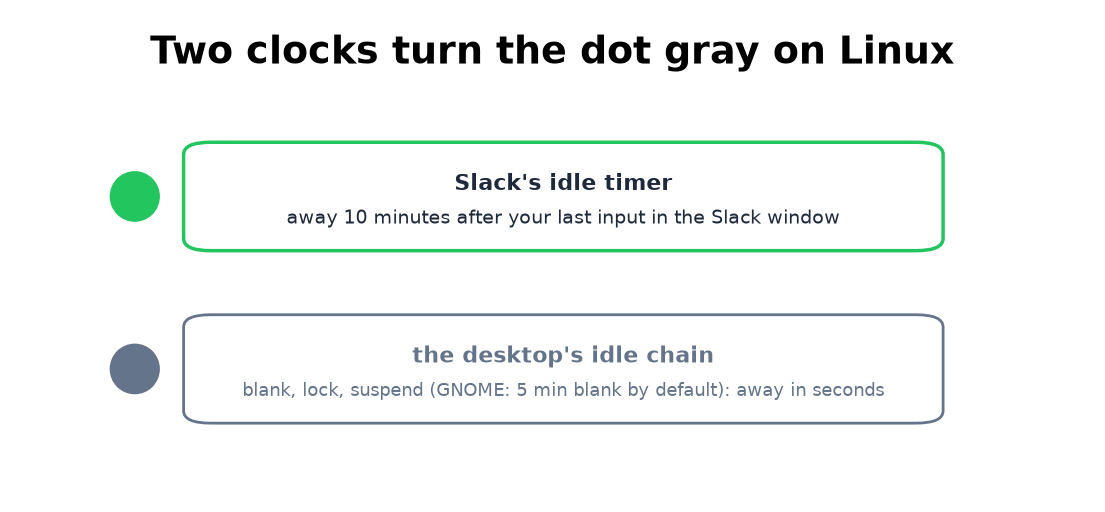
The two clocks on Linux
Slack's idle timer. Ten minutes without typing, clicking, or scrolling inside the Slack window, on any distro and any package format: deb, rpm, snap, or flatpak all behave the same. Input to other windows does not count, because Slack cannot see input outside its own surface, and no setting changes the 10 minutes.
The desktop's idle chain. GNOME blanks the screen after 5 minutes of stillness by default and suspends on battery after 20; KDE and others ship their own numbers. A blanked-then-locked or suspended session reports nothing, so the dot dies long before Slack's timer would have fired. On most setups this chain, not Slack, is what marks you away first.
Stop the desktop from cutting you off
On GNOME, two settings and one command cover it:
- Screen Blank. Settings, Power, Screen Blank: set it longer than your longest stretch away, or Never.
- Automatic Suspend. Same panel, turn it off while you need the dot, at least on AC power.
- One command instead.
gsettings set org.gnome.desktop.session idle-delay 0disables idle blanking; on X11,xset s off -dpmsdoes the same at the display level.
On KDE, the equivalents live in Energy Saving; on anything else, look for idle, blank, and suspend timers. The generic tool that works everywhere systemd runs:
systemd-inhibit --what=idle:sleep sleep infinity
It holds idle and sleep inhibited until you stop it. The GNOME Caffeine extension does the same from the top bar.
Now the limit, and it is the same limit as on every platform: all of this stops only the sleep clock. A wide-awake Linux box still shows you away 10 minutes after your last input in the Slack window. Inhibitors create no input; the same-family test for keep-awake tools is in does Caffeine keep Slack active.
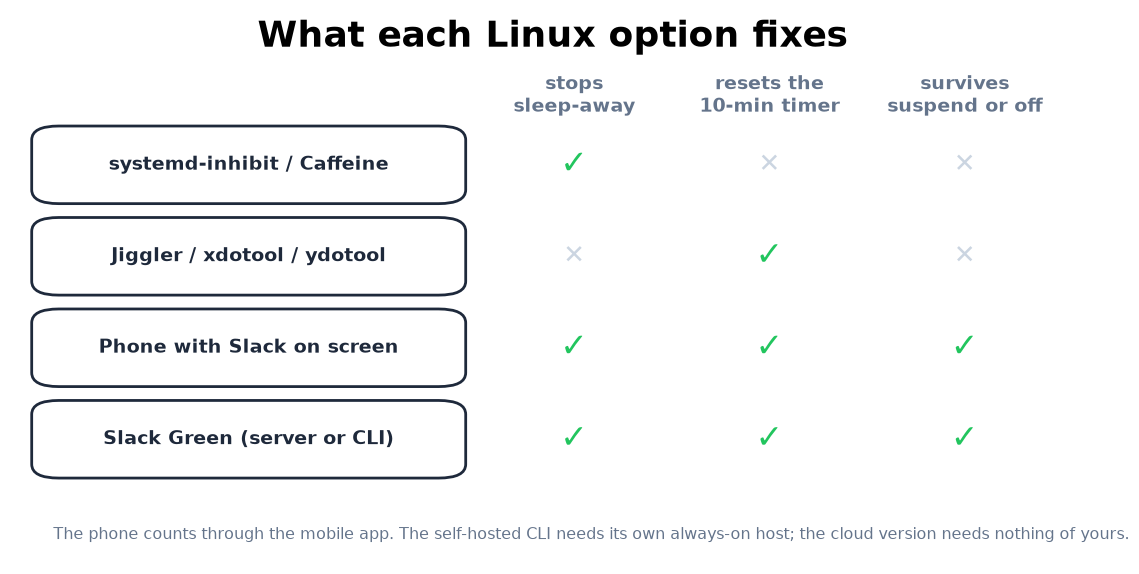
What resets Slack's timer on Linux
Больше никогда не показывать "отошёл" в Slack
Облачное решение. Без загрузок. Работает 24/7 даже при выключенном ноутбуке.
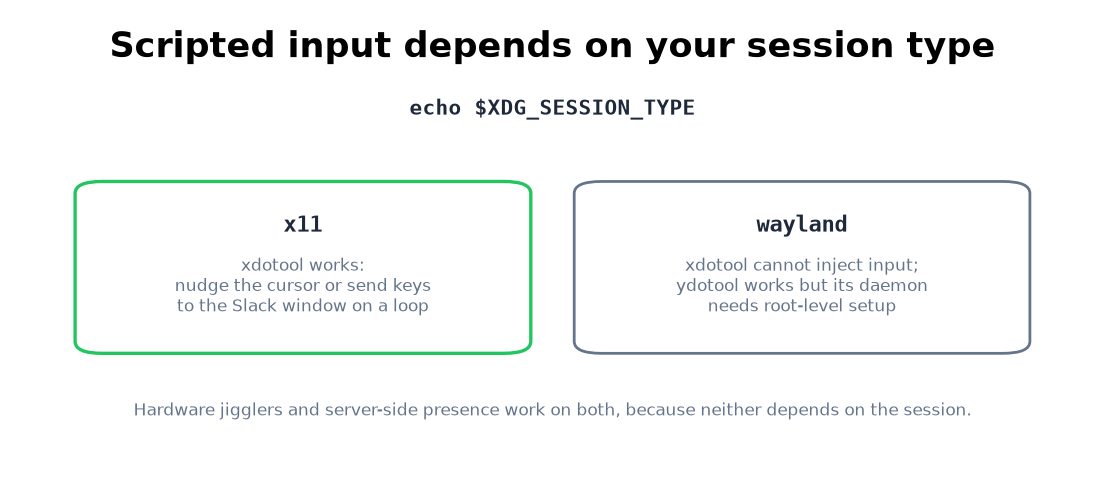
echo $XDG_SESSION_TYPE before you build the script.If the dot goes gray while you are typing in Slack itself, that is not a timer problem: Slack keeps showing away while working.
Linux questions people search
Does systemd-inhibit keep Slack active? No. It stops idle and sleep, which prevents the instant sleep-away, and leaves the 10-minute idle timer running.
Does the Caffeine GNOME extension keep Slack green? Same class: it inhibits the idle chain and creates no Slack input.
Why does my xdotool script do nothing?
You are probably on Wayland. echo $XDG_SESSION_TYPE answers it; on Wayland use ydotool or a hardware jiggler, or move the problem off the machine entirely with a server-side session.
Is the snap or flatpak Slack different for presence? No. Sandboxing changes file access, not the idle timer. All package formats report presence the same way.
Can I keep Slack active with the machine suspended? Not from the machine. A suspended box reports nothing. A second device or a server-side session are the options that survive suspend, compared in how to keep Slack active.
The short version
Fix the desktop chain first: Screen Blank and Automatic Suspend in GNOME, Energy Saving in KDE, or systemd-inhibit --what=idle:sleep, because default idle settings mark you away minutes before Slack's own timer. Then feed the 10-minute timer: by hand, with a jiggler, with xdotool on X11 or ydotool on Wayland, from a phone, or from a server with Slack Green, self-hosted if you prefer your tokens on your own hardware.
Хватит Двигать Мышкой.
Сотни удалённых работников больше не беспокоятся о статусе Slack. Настройте один раз, оставайтесь зелёными навсегда.
Related Articles
Funny Slack Status Ideas That Survive a Work Channel
Copy-paste funny Slack statuses sorted by situation: deep work, meetings, lunch, Friday, and out of office. The two rules that keep a joke work-safe, and why the status never touches your green dot.
Как Slack решает, что вы отошли: четыре сигнала
Slack определяет ваш статус по четырём сигналам и ни по чему больше: ввод внутри клиента Slack, сон и блокировка машины, приложение на экране телефона и ручной переключатель «нет на месте». Календарь, другие приложения и мышь вне окна Slack до решения не доходят.
How to Keep Teams and Slack Active at the Same Time
Slack counts input inside its own window on a 10-minute timer. Teams reads keyboard and mouse anywhere, on 5. One trick rarely covers both, and the setups that do are specific.