
Slack Away Status Meaning: What the Grey Dot Tells You
Away on Slack means the person has no active Slack session right now, or set themselves away. What the hollow grey dot means, a tested look at manual away, how it differs from offline and Do Not Disturb, and how to switch it off.
Free tool, runs in this tab
Keep your screen awake and see when Slack sets you away
Press Start. This tab keeps the screen on while it stays open, and shows the minute Slack, Teams and Zoom would set you away if nothing touches the keyboard or mouse.
This tab cannot move your pointer or press keys, so on its own it cannot keep Slack or Teams active. It reads the same idle time the Slack desktop app, Teams and Zoom read. To test a jiggler, start, then take your hands off for 6 minutes: if Your computer stays green, the jiggler keeps them active.
- Your computerNot measured yetPress Start and allow idle detection.
- Slack desktop app-Away after 10 min, any input.
- Microsoft Teams-Away after about 5 min, any input.
- Zoom-Away after 15 min by default, any input.
Away on Slack means that person has no active Slack session right now: none of their computers saw keyboard or mouse input for 10 minutes, their phone app is closed, or they set themselves away by hand. Slack Green keeps you active from a server while the computer is off, asleep, locked or closed, free for 7 days with no card.
Their dot is a hollow grey circle instead of a filled green one. A sleeping computer, signing out and Set yourself as away all look the same from the outside.
Away does not mean busy, blocked, or gone for the day. Messages still arrive and notifications still fire. The one exception is @here, which notifies only members who are active, so an away person misses it; see @here vs @channel vs @everyone. Away only says "not at Slack at this moment". People who write "AFK" are saying the same thing on purpose; see what does AFK mean in Slack. How teams handle away, and what to put in a status instead, is in Slack status etiquette.
This page covers the icon and the word, with a test of manual away we ran in our own Slack workspace on 1 October 2026. For the timer itself, read how Slack decides when you are away.
What the away icon looks like
Slack has two presence states: active and away. The dot next to a name shows which one applies, and a small z on top shows paused notifications.
| Icon | Meaning |
|---|---|
| Filled green dot | Active. A computer of theirs with Slack open saw input in the last 10 minutes, or the phone app is open on screen. |
| Hollow grey dot | Away. No active session right now. |
| Green dot with a z | Active, with notifications paused (Do Not Disturb). |
| Grey dot with a z | Away, with notifications paused. |
Slack's help center puts it in one sentence: you are set to active when Slack is open on your desktop or mobile device, and to away after 10 minutes of desktop inactivity or when you leave or close the app on your phone. If the z is what confused you, our guide to the green dot with a z in Slack covers every combination.
What manual away looks like: our test
We clicked our profile picture in Slack in the browser and chose Set yourself as away. The dot next to our name turned into a hollow circle, the menu said Away, and the menu item changed to Set yourself as active.
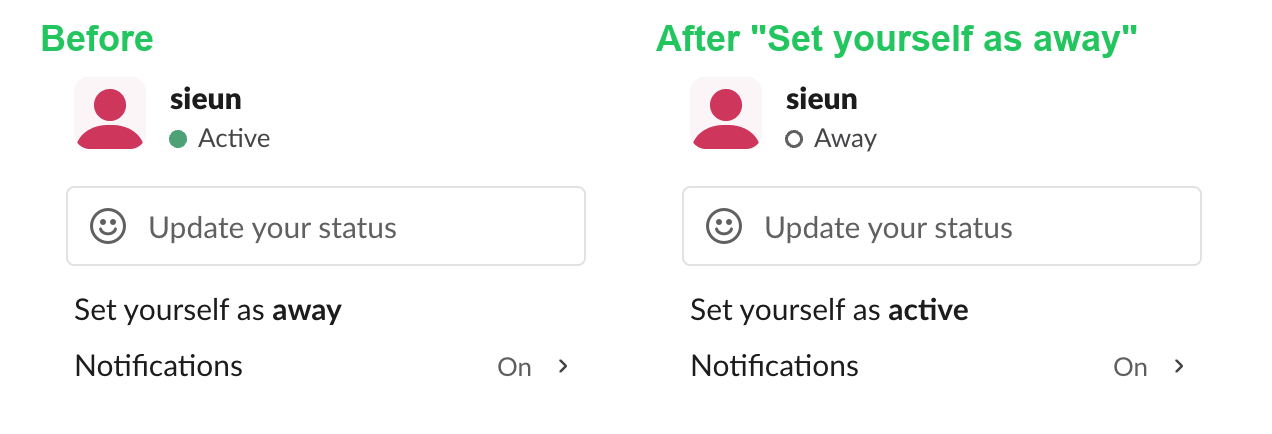
Then we typed a message in the composer and pressed Enter, the kind of input that keeps you active on a normal day. The dot stayed hollow:

Slack's users.getPresence API, called right after the message went out, returned this (trimmed):
{
  "presence": "away",
  "manual_away": true,
  "auto_away": false,
  "online": true,
  "connection_count": 3
}
So Slack knew we were connected on three sessions and had just typed, and still reported away, because manual_away wins. Choosing Set yourself as active returned "presence": "active" and "manual_away": false at once. Two things follow: a person who set themselves away stays grey while they chat, and a grey dot does not mean the person is disconnected.
Your own dot turns grey the same way, 10 minutes after your last keyboard or mouse input or as soon as the laptop sleeps. A server-side tool keeps your Slack dot green with no input, even with the laptop closed or the phone locked.
Five ways someone ends up away
- Ten minutes without input. The Slack desktop app counts clicks, keys and mouse moves in any app (Slack desktop 4.52.178 code, checked 7 Oct 2026), so a person typing in a document stays green, and a person on a long call or reading without touching anything goes grey. The per-device numbers are in how long Slack stays active.
- They set themselves away. Manual away sticks. In our test the dot stayed grey after we typed and sent a message, until we chose Set yourself as active.
- They left the phone app. On mobile you are active only while Slack is on screen. Switching apps or locking the phone sets you away.
- The computer slept or locked. The session stops reporting, so presence goes grey soon after.
- They signed out or have Slack closed. A person on vacation looks the same as a person who stepped away two minutes ago.
- • 🌴 Palm tree: a vacation status. The person set "Vacationing" as their status text. Their dot can still be green.
- • 📅 Calendar: "In a meeting", often set by the Google Calendar or Outlook app for Slack.
- • 🎧 Headphones: they are in a huddle.
- • 👀 Eyes: as a reaction on a message, it means "I am looking at this". It is not a status.
- • z on the dot: notifications paused. See Slack Do Not Disturb.
- Click your profile picture in the sidebar.
- Click Set yourself as away. To undo it, open the same menu and click Set yourself as active.
- Tap your profile picture.
- Tap Set yourself away or Set yourself as active.
Because every route ends in the same dot, you cannot tell from the outside which one happened. Slack also shows no "last seen" time. We checked that in does Slack show last seen.
Away vs offline on Slack
There is no separate offline state. Slack draws idle, manually away, and signed out with one hollow grey dot. Some people and some older guides call it "offline", but the Slack menu and the presence field of the API only know active and away. Our test shows the gap: the API said away while the same account had three open connections.
This is also why you can appear offline on Slack with one click: setting yourself away gives you the same dot as a person whose laptop is closed.
Away vs active vs Do Not Disturb vs status
People mix these up because they all sit next to your name. They are separate systems:
| Setting | Who sets it | What others see | Stops your alerts? |
|---|---|---|---|
| Active | Slack, from your input | Filled green dot | No |
| Away | Slack after 10 minutes, or you | Hollow grey dot | No |
| Do Not Disturb | You or your notification schedule | A z on the dot | Yes |
| Custom status | You or a connected app | Emoji and text by your name | Only if you tick Pause notifications |
A custom status such as "In a meeting" does not make you away, and being away does not clear your status text. The two only look related. Slack active status explained shows how the dot and the text stay apart.
Other symbols people mistake for away
To set any of these for yourself, follow how to change your status on Slack.
How to set yourself away, or turn away off
Desktop and browser:
Mobile:
If you did not set yourself away and the dot still turns grey while you work, the cause is the 10-minute timer, a second device, or a sleeping machine. The cause-by-cause guide is Slack keeps showing me away while working, and the fixes are in how to stop Slack from showing away.
Keeping your dot green while you work elsewhere
Slack has no setting that changes the 10-minute timer or pins your dot green. Every option feeds the timer from outside: input on the computer, keeping the phone app open, or a server that holds your session. A server-side tool keeps you active while the computer is off, asleep, locked or closed, with no software or hardware on the computer. The options side by side are in how to keep Slack active.
FAQ
Can you still message someone who is away?
Yes. The message arrives, and they get a notification as usual unless they paused notifications (a z on the dot). The one exception is @here, which skips people who are away.
Does typing in Slack turn manual away off? No. In our test the dot stayed grey after we typed and sent a message. Only Set yourself as active ends it.
Why does a coworker never show as away? They probably have another active session, such as the phone app open on their desk, or they use a tool that keeps their presence active. One active session anywhere keeps the dot green.
Does Slack tell people I set myself away? No. Manual away looks the same as being idle or signed out. There is no label and no timestamp.
Related Articles
Can You See Slack Status History? No, Here Is What Exists
No. Slack shows your active or away dot and your custom status only as they are right now, and keeps no history of either that coworkers or admins can open. Admins on paid plans see a last active date and sign-in logs. How to keep your own status log with the Slack API, from today on.
Slack: Get Notified When Someone Comes Online (No Built-In Alert)
Slack has no alert for when a coworker becomes active. No preference, Workflow Builder trigger or profile button does it. You can watch their green dot, send a message they will see when they return, or run a short script that checks users.getPresence every minute and DMs you.
Slack Active on Multiple Devices: Which One Sets Your Status?
When you use Slack on a phone and a computer at once, one active device keeps you green, and a manual away set on any device makes you away on all of them. We measured connection_count per browser tab and a manual away across four connections.