
Slack Free Plan Limits: What You Lose Without Paying
The Slack free plan shows only the last 90 days of messages and files, deletes data older than one year, allows 10 apps, and limits huddles and Slack Connect to one-on-one. Every limit from Slack's help center, what happens at day 90, and when upgrading is worth it.
The Slack free plan has five limits that matter. You can see and search only the last 90 days of messages and files. Data older than one year is deleted on a rolling basis. You can install 10 apps. Slack's own RSS app installed on our Free workspace with no upgrade step in our Slack RSS feed test. Huddles are one-on-one only. Slack Connect works only in one-on-one DMs with people outside your company. Workflows, canvases, lists, guest accounts, user groups and AI features need a paid plan. Slack's help center lists no cap on the number of members in a free workspace.
Every Slack free plan limit
| Feature | Free plan | Pro ($7.25 a user a month, paid yearly) |
|---|---|---|
| Message and file history | Last 90 days visible and searchable | Unlimited |
| Data older than one year | Deleted on a rolling basis | Kept for the life of the workspace |
| Apps and integrations | 10 third-party or custom apps | Unlimited |
| Huddles | 1:1 only | Up to 50 people, 25 on video |
| Slack Connect | 1:1 DMs only | Channels with up to 250 organizations |
| Workflow Builder | Not available | Included |
| Canvases and lists | Not available (read-only after a downgrade) | Included |
| Guest accounts | Not available | Included |
| User groups and custom sidebar sections | Not available | Included |
| AI summaries and huddle notes | Not available | Included |
| Workspaces | 1 | 1 |
Sources: Slack's help center articles "Usage limits for free workspaces" and "Feature limitations on the free version of Slack", and slack.com/pricing, checked on 23 September. Slack also applies a high-volume limit on the free plan: it may stop you sending many messages or files in a short time, to limit spam and storage use. The cap per file does not shrink on Free: our file size limit test uploaded exactly 1 GB (1,073,741,824 bytes) to a Free workspace. Those files live on Slack's servers, not on your computer; where Slack files are stored shows the private address each one gets.
What a Free workspace shows its owner
We opened the admin pages of our own Free workspace, where we are the Primary Owner, on 2 October 2026. Two things there are not in the pricing table. Canvas version history is one of the switches there, and it works on Free, as Slack canvas version history shows.
The Analytics overview still measures usage against the old Free limits of 10,000 messages and 5 GB of files, plus the 10-app cap that still applies:
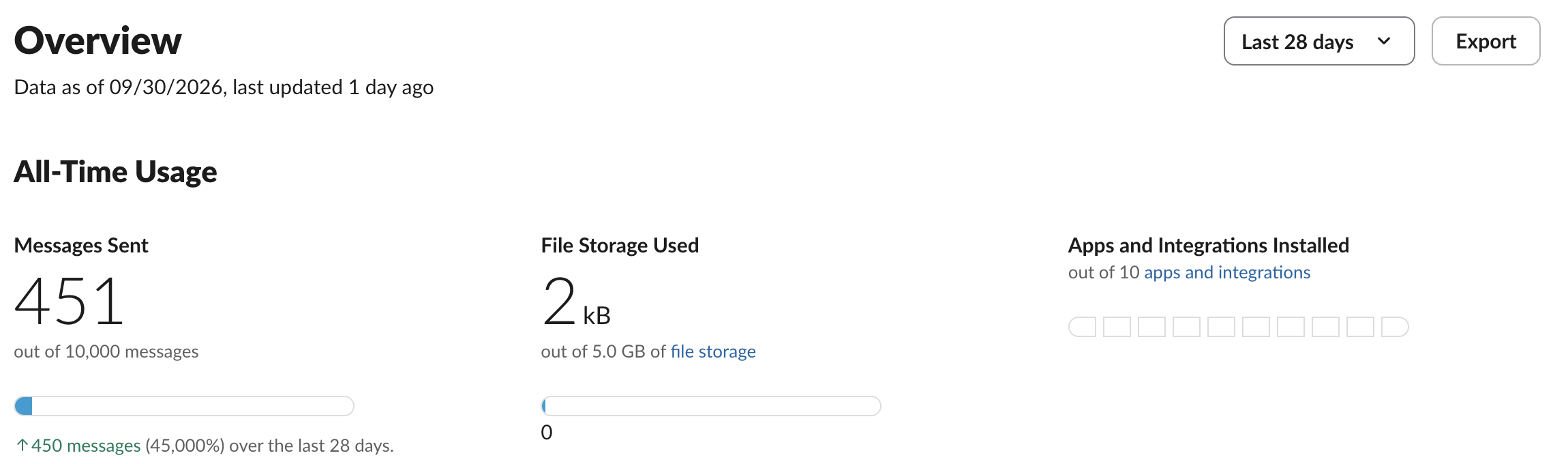
The 90-day rule is what Slack's help center describes for history today; the message and storage bars in this panel are from the older plan, and the panel says its data was a day old. The Analytics menu on Free has only Overview and Channels, so there are no per-member numbers. Its Export button still downloads daily message counts, which Slack analytics on the Free plan goes through column by column.
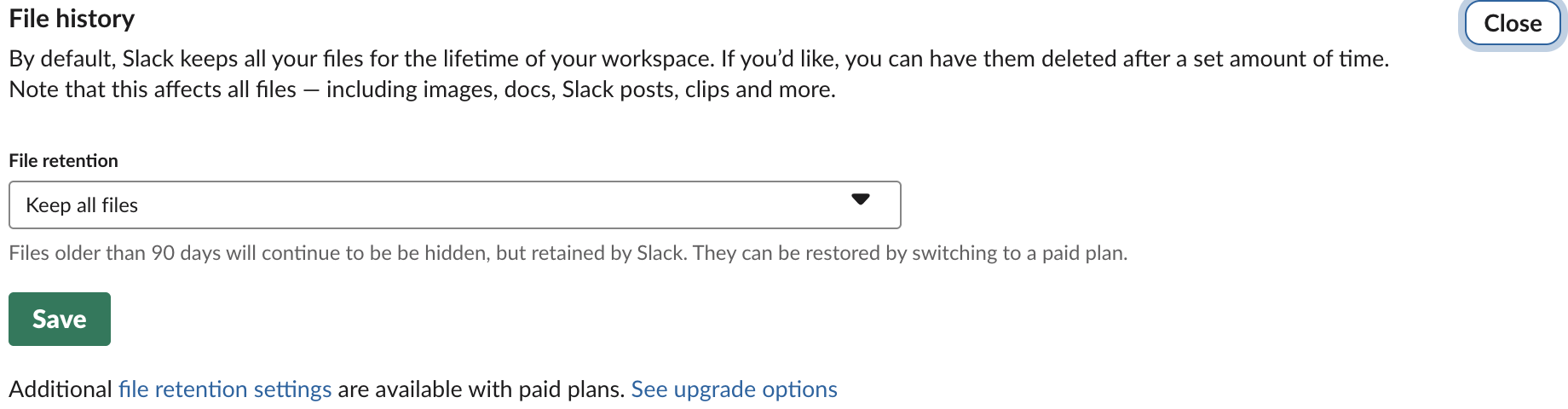
Under Settings & permissions, File history says in plain words what happens to old files on Free:
Data retention for messages offers two choices on Free: keep all messages without tracking edits or deletions (the default), or keep them for 90 days. Never delete and a custom period are greyed out as paid features. We read these on 1 October and did not change them.
Does Slack delete messages after 90 days?
No, not by default. After 90 days, messages and files are hidden, not deleted. Slack's help center says free workspaces can view and search the last 90 days only; older messages are hidden to make room for new ones, and messages and files more than one year old are permanently deleted. Slack started those deletions on August 26, 2024.
Two exceptions:
- • If the workspace Owner chose Delete messages after 90 days in the data retention settings, hidden messages are deleted right away instead of kept for a year.
- • If the workspace upgrades to a paid plan, the hidden messages that are less than a year old become visible again.
Hidden history also changes how Jump to date behaves: picking an old day in our free workspace scrolled to the next visible message, weeks later, with no notice, as shown in Slack jump to date.
The full retention rules for every plan are in Slack message retention policy. To keep a copy of your own messages before they go, see how to export Slack messages without admin.
Slack free plan user limit
Slack's help center lists no member limit for free workspaces. The limits are on history, apps and features, not on headcount. In practice, large free communities run into the 90-day history limit and the missing guest accounts first. Slack's pricing page bills paid plans per active member: someone who does nothing in Slack for 28 days stops counting.
Never appear "away" on Slack again
Cloud-based. No downloads. Works 24/7 even when your laptop is off.
Huddles on the free plan
Free workspaces can huddle one-on-one in DMs, with audio, video and screen sharing. A huddle in a channel with three or more people needs a paid plan, where huddles hold up to 50 people and 25 on video. Many free teams pair Slack with a free video tool for group calls; the options are in Slack huddles vs Zoom.
Apps, workflows and Slack Connect
Apps: you can install up to 10 third-party or custom apps. When you reach the limit, uninstall one to add another. Built-in features do not count. A translation app from the Marketplace takes one of those slots; how to translate Slack messages covers a way to translate on Free without one.
Workflows: Workflow Builder is a paid feature. After a downgrade, existing workflows stop and you cannot create new ones. Slash commands like /remind still work on free; see Slack /remind examples.
Slack Connect: on free, you can DM one person at another company. Shared channels with other companies need Pro or above.
Slack free vs paid: when to upgrade
The free plan is enough for a small team that talks every day, rarely looks back further than three months, and holds group calls somewhere else. Upgrade when you need history older than 90 days, group huddles, shared channels with clients, workflows or canvases. Pro costs $7.25 a user a month paid yearly, or $8.75 monthly. Business+ ($15 paid yearly) adds AI search answers, recaps and more; see is Slack Pro worth it and is Slack AI worth it.
If the price is the problem, free Slack alternatives compares tools that keep full history for free.
FAQ
Does the Slack free plan limit file storage?
The admin usage panel in our Free workspace still showed a 5.0 GB bar, but the rule that bites first is time: files older than 90 days are hidden, and the File history setting says they "can be restored by switching to a paid plan".
Can I see old messages if I upgrade?
Yes, if they are less than one year old. Upgrading reveals messages hidden by the 90-day limit that have not been deleted yet.
Stop Jiggling Your Mouse.
Join hundreds of remote workers who never worry about their Slack status. Set it up once, stay green forever.
Related Articles
Slack Analytics on the Free Plan: What Owners Can See and Export
On a Free workspace, Admin > Analytics shows one overview page and an Export button with daily message counts. Channel, file and member analytics need a paid plan. We opened every tab and read the CSV.
Free Slack Alternatives That Keep Your Full Message History
Slack's free plan hides messages after 90 days. Pumble, Discord and Chanty keep unlimited history for free; Mattermost, Element and Rocket.Chat are free if you host them; Google Chat and Teams free cost nothing if you already use Google or Microsoft. What each free plan limits, from each vendor's pricing page.
Slack Message Retention: How Long Slack Keeps Messages, Tested on Free
Paid plans keep messages for the life of the workspace. On Free, a busy channel showed messages back to exactly 90 days and nothing older. Real settings and options below.