
Teams Away vs Offline: What Each Status Means and Who Sets It
In Microsoft Teams, Away means you are signed in but idle, locked, on a backgrounded phone, or set it by hand. Offline means no device is signed in, the computer is asleep, or you chose Appear offline. What each tells coworkers, and how messages and calls behave.
In Microsoft Teams, Away means you are signed in but Teams sees no activity: about 5 minutes without keyboard or mouse input, a locked screen, Teams in the background on your phone, or Away set by hand. Offline means Teams sees no device signed in at all: you signed out, the computer is asleep, or you picked Appear offline. Away is a yellow clock and Offline is a grey circle with an x. Messages reach you in both states.
Microsoft's admin documentation puts it this way: on a computer, presence "becomes Away automatically if they're inactive for a few minutes or if the computer is locked; and it becomes Offline when the computer enters sleep mode." Slack has only two states, active and away, and its own timer; Slack Green keeps the Slack dot green from our servers during the hours you set.
Away vs Offline at a glance
| Away | Offline | |
|---|---|---|
| Icon | Yellow circle with a clock | Grey circle with an x |
| Teams is running? | Yes, on at least one device | No device connected, or hidden by Appear offline |
| Set automatically when | About 5 minutes without input, screen locked, phone app in the background | Computer asleep, signed out, or no device for a few minutes |
| Set by hand | Appear away, or Be right back | Appear offline |
| Last seen time shown | Yes | Yes |
| Chat messages | Delivered, with notifications on your devices | Delivered; notifications on any device still signed in |
| Where it ranks | Above Offline | Lowest |
Both show a "Last seen" time on your profile card; how it is set is in what does Last seen mean on Teams.
The four statuses that look alike
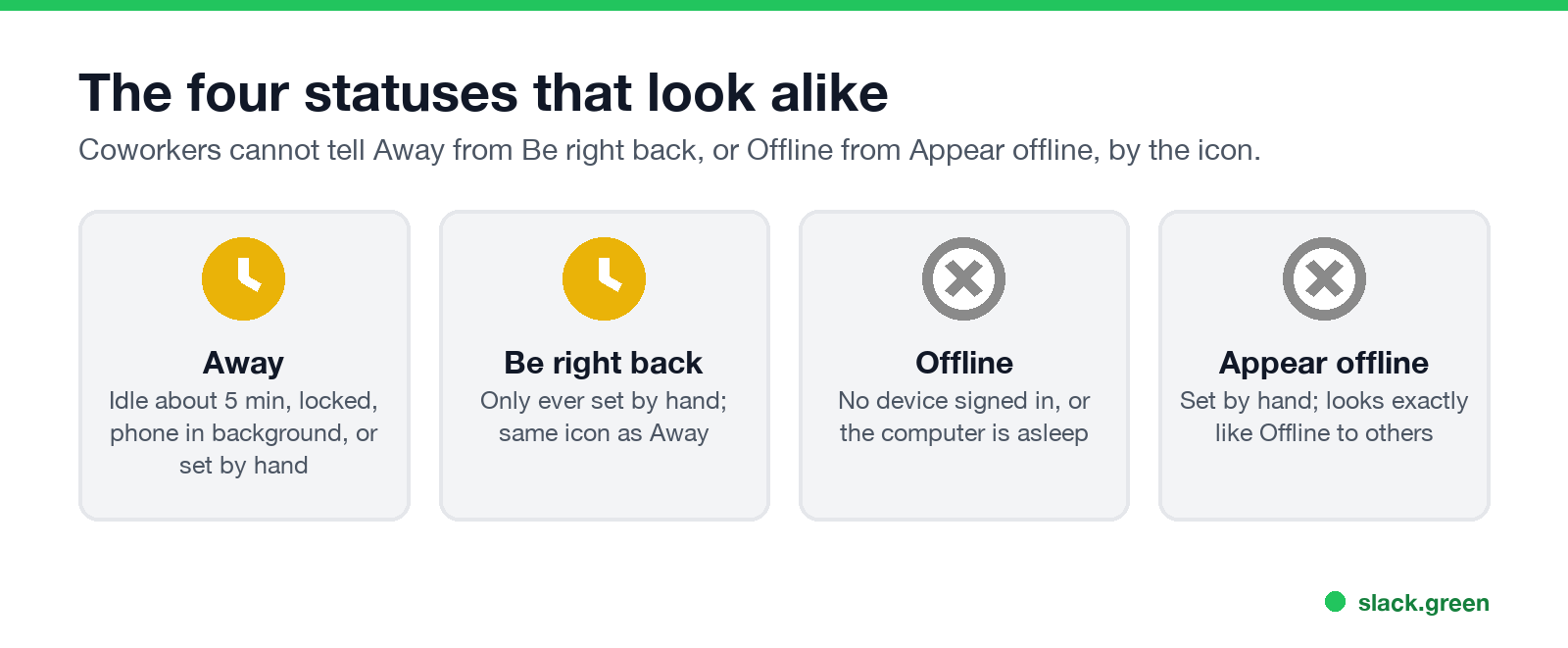
- • Away vs Be right back. Same yellow clock. Teams sets Away by itself when you are idle, and you can also choose Appear away. Be right back is never set automatically; someone chose it. The automatic kind is what people call inactive, covered in what does inactive mean on Teams.
- • Offline vs Appear offline. Same grey x. Coworkers cannot tell whether you are signed out or hiding. Appear offline lasts until you change it, and you keep using Teams normally; how to set it and what still gives you away is in how to appear offline on Teams.
Hover over a name to see the status in words. The icon alone does not say who set it.
How Teams moves you from Away to Offline
Never appear "away" on Slack again
Cloud-based. No downloads. Works 24/7 even when your laptop is off.
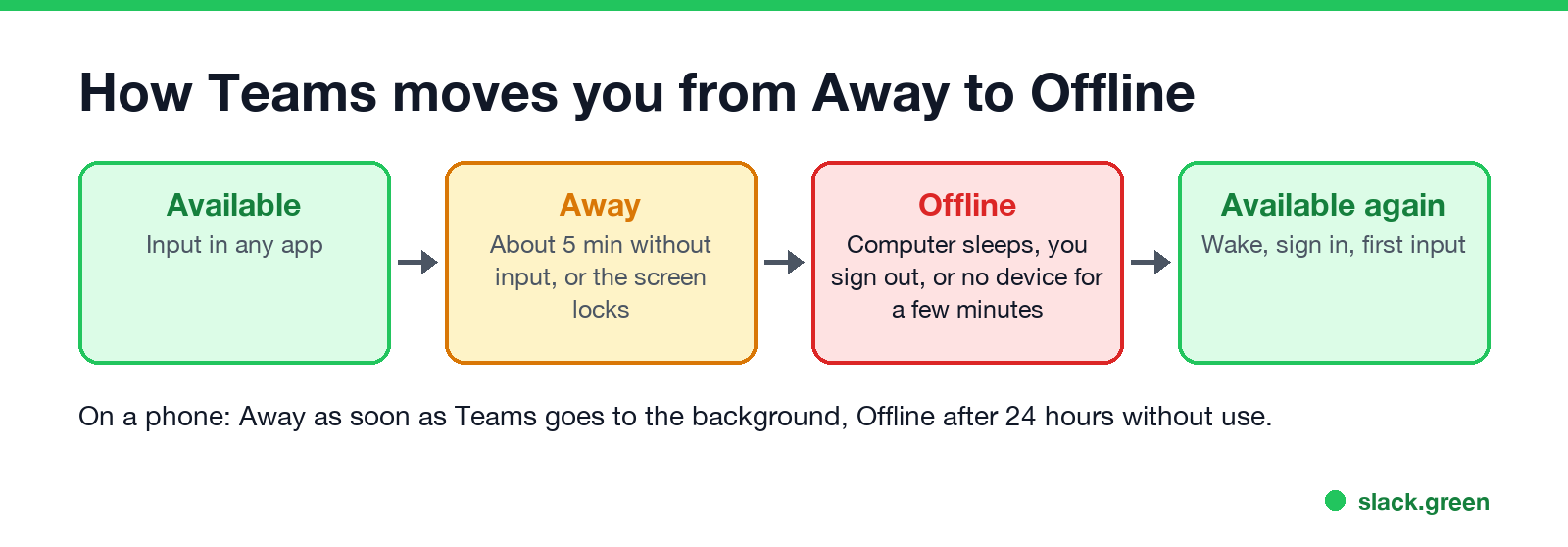
On a computer, the order is Available, then Away after about 5 minutes without input or when you lock the screen, then Offline once the computer sleeps or you quit and sign out. Closing the lid usually means sleep, so a closed laptop reads as Offline within minutes; details in does Teams stay green when the computer is asleep.
On a phone, Teams shows Away as soon as the app goes to the background, and Microsoft says it becomes Offline "after 24 hours of inactivity". When you use more than one device, Teams shows the status of the device you used most recently, so your phone can show you Away while your laptop is asleep.
What coworkers can assume from each
Away says "signed in, not at the keyboard right now". A reply is likely soon, and people often message anyway. It says nothing about why: a meeting in a room, lunch, or reading a printout all look the same.
Offline says "not in Teams on any device, or hiding". People usually expect a reply later. If you use Appear offline during work hours, a manager who checks your status sees the same thing as if you had signed off.
Neither status blocks anything. Chats are delivered either way, and you see them when you look. For calls, a signed-in device can still ring while you show Away; with no device signed in, the caller gets voicemail or a missed call.
How to change between Away and Offline yourself
You can also type /away or /offline in the search box at the top of Teams. If Teams keeps showing Away when you did not choose it, work through Teams status stuck on Away.
FAQ
Never appear "away" on Slack again
Cloud-based. No downloads. Works 24/7 even when your laptop is off.
What is the difference between Away and Offline in Teams? Away means you are signed in but idle, locked, or set it by hand. Offline means no device is signed in, the computer is asleep, or you chose Appear offline.
Does Offline mean someone signed out of Teams? Not always. Appear offline looks the same as being signed out, so the person may be using Teams.
Can I still message someone who is Away or Offline? Yes. Messages are delivered in both states and wait until the person opens Teams.
How long before Teams goes from Away to Offline? On a computer, when it sleeps or Teams is closed. On a phone, after 24 hours without using Teams.
Is Be right back the same as Away? They share the yellow clock icon, but Be right back is only ever set by hand.
Stop Jiggling Your Mouse.
Join hundreds of remote workers who never worry about their Slack status. Set it up once, stay green forever.
Related Articles
KeepingYouAwake vs Amphetamine: Which Mac Keep-Awake App to Use
KeepingYouAwake is a free, open-source menu bar switch that runs Apple's caffeinate for you. Amphetamine is a free App Store app with triggers, schedules and a closed-lid mode. Pick KeepingYouAwake for one click and Homebrew, Amphetamine for automation. Neither keeps Slack or Teams active.
Computer Locks After 15 Minutes? How to Tell If Group Policy Set It
A work laptop that locks after exactly 15 minutes, with screen settings greyed out, is almost always following a policy from IT: the Windows machine inactivity limit, a forced screen saver, or an Intune device lock. Security baselines and PCI DSS ask for 15 minutes. How to see which policy it is, and what you can and cannot change.
How to Keep a Citrix Session Active: Find Which Timeout Logs You Out
A Citrix session can end from four different timers: Windows locking inside the virtual desktop, the Citrix session idle timer, the Citrix Gateway session time-out, and the StoreFront web page timeout. Only input from your own device into the Citrix window resets them. How to tell which one hit you and what keeps each one quiet.